
Blog
Marketers weigh in: Why digital-forward brands still leverage direct mail marketing
Financial Institutions: Data-Driven Marketing, Market Your Business
 5 Minutes
5 Minutes

While digital dominates the conversation in most marketing circles, physical channels are still driving some of the highest-value customer outcomes. Why? Because physical media has something digital doesn’t: It’s tangible, touchable and trusted. And in an increasingly crowded digital world, it’s a smart way to stand out.
We sat down with marketing experts to discuss why direct mail is still a powerful lever, even among brands with a digital-forward voice. What it came down to was differentiation, precision and quality.
1. Physical marketing is received differently than digital (even among younger audiences)
Those who grew up on the cusp of the “Internet Age” likely understand that physical media is easier to commit to memory than digital. Studies confirm this: The tactile and spatial feedback from print media creates a stronger “cognitive map,” which helps strengthens comprehension and retention. With endless ways to market to consumers, there are only a few that exist in the physical world, with direct mail being one of them.
“When I think about direct mail, that strength is so unique and powerful,” shares Nicole Bond, Senior Director and Head of Insights at Comperemedia. “Outside of branded merchandise, when can a consumer actually physically interact with your brand?”
Even younger consumers respond positively to getting direct mail. It may seem like the best choice to target Gen Z and younger millennials through digital media due to their digital savviness, but over-saturation is real.
70% of consumers feel positive about receiving direct mail, and 61% of those like the qualities of direct mail that cannot be replicated by digital ads. |
“Gen-Z and younger millennials actually gravitate towards mail because what's old is new again,” Bond explains. “When something shows up in their mailbox, it feels special, it feels unique.”
Younger audiences also have different perceptions about the mail. “Older generations associate mail with statements, past due notices and collections,” Bond says. “Younger generations associate mail with coupons from their favorite brands or a birthday card from Grandma with a little cash in it. So, when they go check the mail, they're excited to see what it brings.”
The way direct mail is perceived can certainly play in a brand’s favor. Thanks to its tangibility and sense of specialness, direct mail can be a powerful compliment to an omnichannel strategy, helping fill the experience gap that digital can’t.
2. Direct mail supports precision targeting, not mass marketing
Direct mail isn’t a firehose. For smart marketers, it’s highly targeted and driven by data.
Saatva, a leading mattress brand that first gained awareness through performance marketing, used targeted direct mail efforts to help them transition to a household name.
“As we've grown our retail footprint over the last few years, our ability to target more granularly with localized media has been more important than ever,” shared Casey Jones, Director of Paid Media at Saatva.
Most consumers only buy a handful of mattresses in their lifetime and tend to do so at key moments in their lives, like moving into a new home.
“We've found a sweet spot as a mattress brand; we are really tied to life cycle events,” Jones says. “We've seen a lot of success with new movers, and we’ve been able to layer in more propensity insights, like their likelihood to purchase within the home furnishings category.” This precise targeting means Saatva’s message reaches those who are actually in the market for their products.
This shift is an upgrade for the traditional marketing channel. With smart data application, today’s direct mail strategies operate more like performance marketing: targeted, segmented and optimized.
3. Physical marketing compliments digital
Ask any marketer with a successful mailer program and they’ll tell you: Direct mail shouldn’t operate in a silo. Like any channel, it’s most powerful when it reinforces overall brand messaging, supporting digital, email, retail and broader media campaigns.
"I like to think of marketing strategy like an orchestra — and direct mail is just one of our instruments,” notes Durrana Nejat, VP Leader of Consumer Digital and Direct Marketing at U.S. Bank. “When we think about our overall marketing or promotional strategy, we look to align direct mail with different offers and strategies, then look at how we're layering digital on top of that.”
To get the most out of your mailers, it’s important to treat this channel the same as any other. “Think about how [direct mail] is going to tie back to attribution and your cost per acquisition,” recommends Vince Monticello, Marketing Director of CRM at Ally Bank. “For me, direct mail has worked really well in combination with email. Perhaps you send out the mailer first, follow-up with the email, or vice versa to control your cost. Any little thing that you can do with sequence and frequency of how you're layering your touch points are really good opportunities to test and drive growth.”
I like to think of marketing strategy like an orchestra — and direct mail is just one of our instruments.
— Durrana Nejat
VP, Consumer Digital & Direct Marketing Leader, U.S. Bank
Another reason marketers love direct mail is how tidy the impact measurement can be, especially compared to the increasing murkiness of digital attribution. Yes, there are hurdles to integrating physical advertising into digital tracking tools, but savvy marketers know finding the right way to measure is worth the effort.
“[Direct mail measurement] is so clean-cut, especially compared to what we're seeing in some of our digital channels,” Jones confirms. “Having the one-to-one match is so helpful to validate what we're seeing.” This feedback loop is especially valuable for a young company like Saatva who is focused on continuing to grow brand loyalty.
4. Direct mail often leads to higher-value customers
According to Comperemedia insights, consumers are more receptive to mail coming from a brand they have a standing relationship with. This is especially evident in the financial services space, something that marketers at U.S. Bank witness all the time.
“There's a sense of trust and credibility when you get a piece of mail,” Nejat shares. “The choices that [mail recipients], either walking to one of our branches or their interactions, they tend to have higher lifetime values.”
But in the direct mail space, patience is key, as the time it takes for a recipient to respond to direct mail is often longer. While an email can get lost and forgotten in one’s inbox, a piece of overlooked mail sitting on the counter is still present in the recipient’s mind.
“We know that direct mail is contributing more than just the smoking gun account that is opened,” Nejat emphasizes. “It’s helping create awareness and consideration. A lot of times it's sitting on that counter for weeks, so it’s continuing to have impact beyond the immediacy that you might see with digital channels.”
Your direct mail strategy shouldn’t be evaluated on immediate response only; expect longer-tail results that help drive deeper, higher-value customer relationships.
5. Quality over quantity is shaping the channel
In 2022, budget cuts led to many brands cutting back on the volume of direct mail they were sending, shifting their focus to quality over quantity. This refinement was applied not only in the mailers that were being sent, but in the audience targeting, timing and relevance of the material.
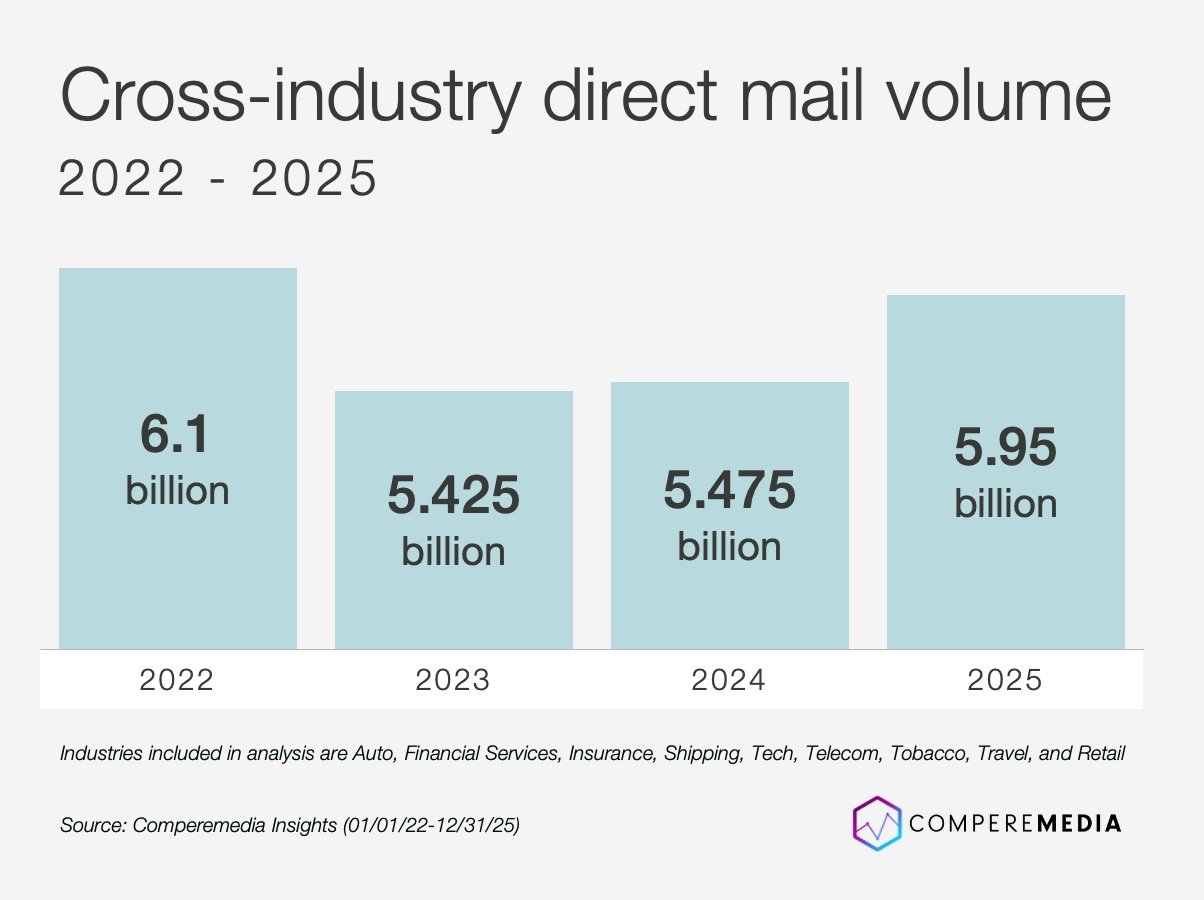
Even as budgets bounced back and volume grew, the focus on quality stuck around. Brands have now “reclaimed” direct mail as a fruitful, viable channel that can go beyond acquisition. Plus, with so much overcrowding in digital spaces, direct mail often is the more affordable option, even with rising postage rates.
“The costs are real, but the cost of any media likely outpaces the increases in direct mail,” Monticello says of his work with Ally Bank. “After you get it stood up and get the attribution model and measurement correct, direct mail can speak for itself.”
The resurgence of direct mail isn’t about sending more mail indiscriminately, but about smarter, more intentional use of the channel. And when compared to digital, the investment often proves out.
“We all have customer acquisition goals that we need to hit and cost per acquisition is key,” Monticello continues. “And if we can prove that it works and pencils out, then it really shouldn't be that hard to fight for the budget for it.”
Even for digital-forward brands, direct mail can be a powerful strategic lever that creates memorable brand moments, strengthens omnichannel campaigns, improves targeting precision and supports deeper customer relationships over time. As marketers continue to balance performance, personalization and trust, the brands that get the most from direct mail will be the ones that use data thoughtfully, measure impact clearly and focus on relevance over reach. With the right strategy and execution, physical marketing can become a meaningful part of a modern growth engine, and the right marketing partner can help bring that strategy to life.
RECOMMENDED RESOURCES


